
Ghost Jobs: Why 1 in 3 Job Listings You're Applying To Might Not Even Be Real
You tailored your resume, wrote a custom cover letter, and heard absolutely nothing back — not even a rejection. Here's the uncomfortable truth: a huge share of job postings online right now aren't real openings at all. Here's how to spot them and stop wasting your time.
Introduction
You've been there. You find a listing that looks perfect, spend two hours tailoring your resume and writing a cover letter that actually sounds like you, hit submit, and then... nothing. Not a rejection. Not an auto-reply. Just silence, forever.
If that's happened to you more than once in the last year, there's a real chance the problem wasn't your resume at all. The job may never have been real in the first place. It has a name now: a ghost job — a listing that stays live on a job board with no genuine, near-term intention of hiring anyone into it. And in 2026, it's become one of the most talked-about, most infuriating problems in the entire hiring market.
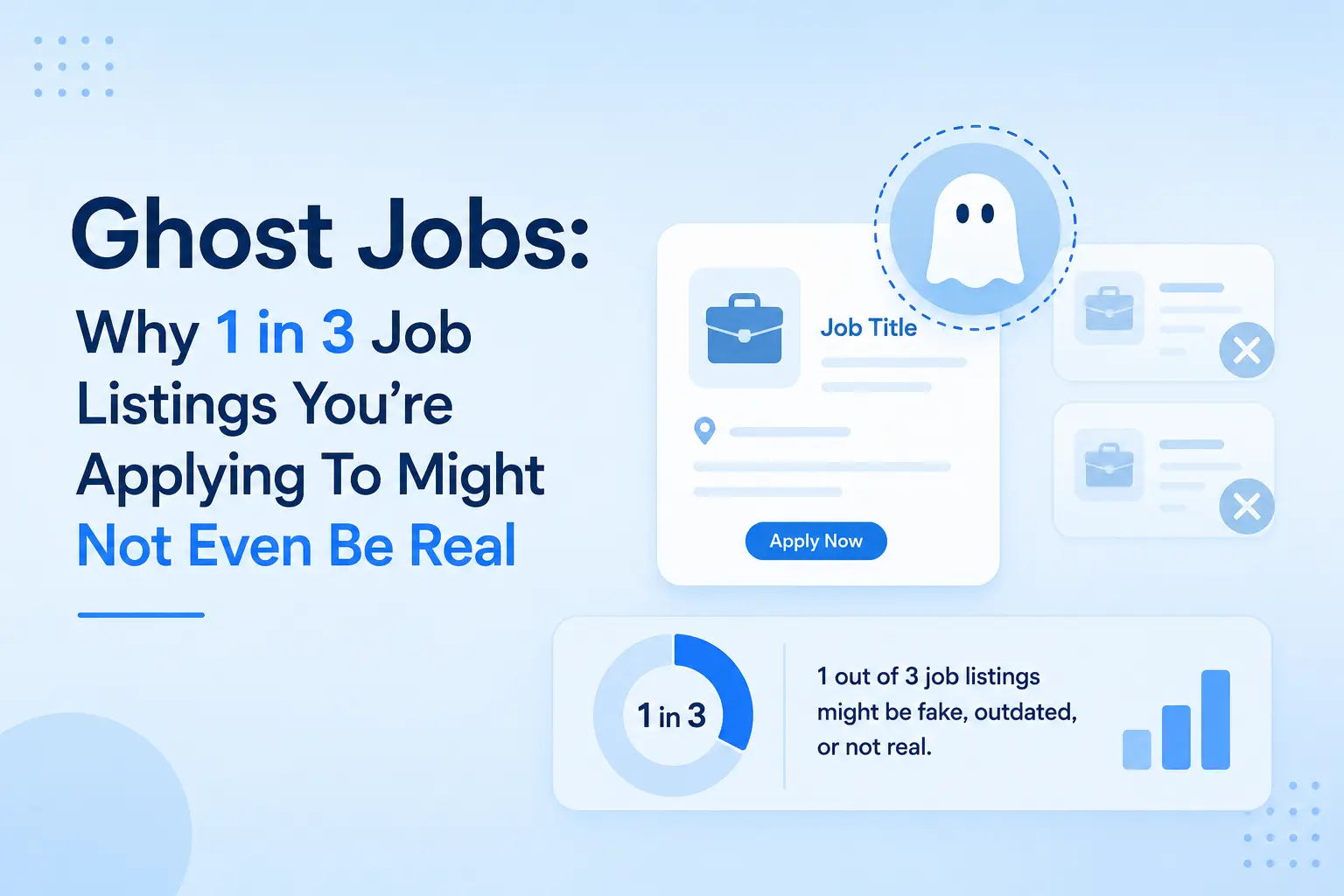
This isn't a fringe complaint. Multiple independent studies now put the ghost job rate somewhere between 18 percent and one in three of all active listings online, depending on the platform and industry. One widely cited analysis of LinkedIn postings found that roughly 27.4 percent of all U.S. listings on the platform show the classic signs of a ghost job. Government roles, education, and healthcare tend to run even higher, with some sector estimates reaching 50 to 60 percent.
Ready to stop wasting hours on listings that lead nowhere? Browse verified, actively hiring roles on HireDoor instead.
The Numbers Are Genuinely Shocking
It's worth sitting with the scale of this for a second, because it explains a lot about why job searching has started to feel broken for so many people.
- A 2026 employer survey found that nearly 1 in 3 companies admit to posting job listings with no current intention of hiring anyone.
- 81 percent of recruiters surveyed admit their own employer has posted at least one ghost job.
- According to Bureau of Labor Statistics data, job openings have outpaced actual hires by more than 2 million positions per month since early 2024 — a gap that can't be explained by hiring difficulty alone.
- The hires-per-posting ratio has roughly halved since 2019, dropping from about 8 hires per 10 postings to just 4 per 10.
- A survey of job seekers found that 47 percent report directly encountering a ghost job in their current search, and in high-competition fields like marketing, that number climbs to 87.5 percent.
- Roughly 37 percent of job seekers report a real financial cost from chasing ghost jobs — travel to fake interviews, paid test assignments, or childcare arranged around interviews for roles that were never actually open.
Perhaps the most damning statistic of all: 7 in 10 hiring managers surveyed said they view posting fake job listings as an acceptable business practice. This isn't a handful of bad actors slipping through the cracks. It's become a normalized part of how a meaningful share of companies operate.
Why Companies Post Jobs They Have No Intention of Filling
The motivations aren't always malicious, which is part of why the practice has become so widespread. The most commonly cited reasons include:
1. Talent Pipeline Building
Roughly half of HR professionals surveyed cite this as the top reason: keeping a stream of pre-screened resumes on file so recruiters have candidates ready the moment a real role does open.
2. Signaling Growth to Investors or Leadership
A long list of open positions can make a company look like it's expanding, even when there's no active plan to fill most of those roles anytime soon.
3. Internal Hires Already Decided
Some companies are legally or procedurally required to post a role externally even after an internal candidate has effectively already been chosen.
4. Testing Salary Expectations
Posting a role — sometimes without a compensation range — lets a company gauge candidate expectations and the broader labor market before committing to a real hire.
5. Keeping Current Employees Uneasy
A less flattering but documented motivation: some employers keep listings for existing roles live to remind current staff that they're replaceable, discouraging pushback on conditions or pay.
Lawmakers Are Starting to Take This Seriously
The scale of the problem has moved well past the point of internet complaints. Ontario, Canada passed legislation effective January 2026 requiring employers with 25 or more staff to disclose whether a posting represents a genuine current vacancy, share a compensation range, and notify interviewed candidates of a hiring decision within 45 days.
In the United States, state lawmakers in Pennsylvania, New Jersey, New York, California, and Kentucky are all currently considering bills that would restrict or ban ghost job postings outright, and the FTC has flagged deceptive job advertising as a priority enforcement area. None of this protects most job seekers yet, but it signals that regulators now view the practice as a genuine consumer-protection issue rather than a harmless recruiting quirk.
How to Spot a Ghost Job Before You Waste an Hour On It
Until regulation catches up, the burden of filtering these out falls on job seekers. Here are the signals worth checking before you invest time in any application:
- Posting age: If a listing has been live for more than 30 to 45 days without any changes, real hiring urgency has usually cooled off or never existed. Genuine openings typically move through a pipeline within a few weeks.
- Missing salary information: Listings with no compensation range at all are more frequently associated with ghost postings than those that disclose pay upfront.
- Only appears on aggregators, not the company's own careers page: If a role is advertised widely on third-party boards but isn't listed on the company's own site, treat that as a red flag.
- "Reposted" badges: On platforms that flag reposted listings, a role that keeps getting relisted without ever closing is a strong ghost-job signal.
- No named hiring manager or specific team: Vague, generic postings with no identifiable point of contact are far more likely to be pipeline-building exercises than active searches.
The single most effective strategy recruiters and career coaches recommend: apply as early as possible in a hiring campaign, and prioritize networking directly with hiring managers over blind applications through job boards whenever you can.
Why This Matters More Than Just Wasted Time
The ghost job crisis is colliding with another trend that's making job searching feel even more exhausting: the average job posting now receives roughly three times as many applications as it did less than a decade ago, driven partly by AI tools that let candidates apply to hundreds of roles automatically. At the same time, employers have responded by leaning harder on automated resume screening, which means job seekers are sending more applications into a system that gives back less signal per application than ever before.
Put those two trends together, and it's easy to see why the median time from starting a job search to receiving an offer has stretched past 100 days in early 2026 — a record high since tracking began. Chasing ghost jobs directly extends that timeline for no benefit at all.
For more on how the broader hiring market is behaving right now, including which roles and companies are genuinely expanding headcount, read our full breakdown of tech hiring trends in 2026.
How HireDoor Is Built Differently
This is exactly the problem HireDoor was built to solve. Every listing on our platform goes through a verification step before it ever goes live, and postings that go stale are actively removed rather than left to accumulate for months. When you apply to a role on HireDoor, you're applying to something a company is genuinely trying to fill right now — not a listing sitting there to harvest resumes or pad a headcount narrative for investors.
We've written before about how this verification-first approach compares to the older, higher-volume model used by legacy portals — you can read the full comparison in HireDoor vs. Naukri, Indeed, and other legacy job portals.
What to Do With the Time You Get Back
If you cut ghost jobs out of your search entirely, you reclaim real hours — time better spent on higher-leverage activities:
- Tailoring your resume specifically for roles you've verified are genuinely active, using our Resume Builder to make sure it's ATS-ready.
- Preparing thoroughly for the interviews you do land with our Interview Guide, instead of spreading thin prep across dozens of applications.
- Researching realistic compensation for verified roles using our Salary Guide before you ever get to the negotiation stage.
- Targeting companies that are genuinely expanding headcount rather than applying broadly to brand names with stagnant or declining hiring activity.
Final Thoughts
The ghost job phenomenon isn't a personal failure or a sign that your resume needs another rewrite. It's a structural, well-documented problem affecting somewhere between one in five and one in three job listings online right now, and it's finally starting to draw serious attention from lawmakers and regulators. Until that oversight fully catches up, the most effective thing any job seeker can do is get sharper about which listings are worth their time — and search on platforms built to filter out the noise in the first place.
Find Your Next Opportunity
HireDoor verifies thousands of active job openings every week, so you spend your time on applications that are actually going somewhere.
