
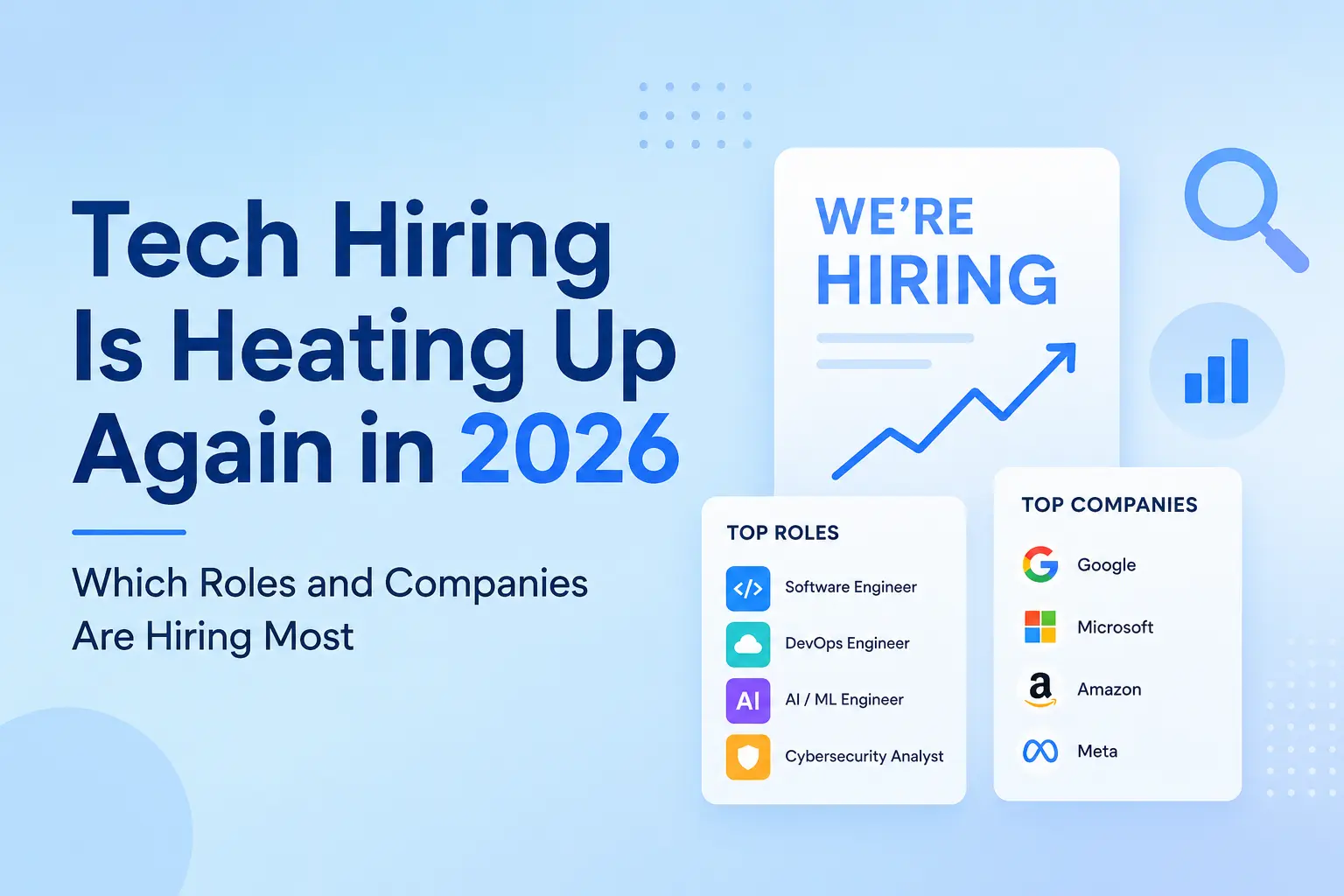
Tech Hiring Is Heating Up Again in 2026 - Which Roles and Companies Are Hiring Most
After two rocky years, tech hiring is picking back up in 2026. Here's what the latest data shows about which companies are expanding headcount, which roles are in highest demand, and how job seekers can position themselves for the rebound.
Introduction
For the past two years, most conversations about the tech job market have centered on layoffs, hiring freezes, and AI replacing entry-level roles. That narrative is starting to shift. Multiple independent data sources now point to the same conclusion: tech hiring is heating up again in 2026, and companies across cloud computing, AI, fintech, and enterprise software are actively expanding their engineering teams.
Technology occupation employment increased by roughly 47,000 workers in a single recent month, and new tech job postings have grown for six consecutive months. The unemployment rate for tech occupations has fallen well below the national average, even as employers say they still struggle to find candidates with the right skills. For job seekers who have spent the last two years hearing that the market is broken, this is a meaningfully different signal.
If you're actively job hunting right now, explore the latest software engineering jobs and internship opportunities on HireDoor to see which companies are hiring today.
The Data: Tech Hiring Is Genuinely Rebounding
Several independent datasets are now telling a consistent story. Analysis of Bureau of Labor Statistics jobs-report data shows tech occupation employment rising again, with employers listing hundreds of thousands of new tech job postings in a single recent month, and this marks the sixth consecutive month of growth in active postings. The unemployment rate for tech occupations has dropped to under 3 percent, well below the national unemployment rate.
Separately, a widely cited technology hiring survey found that more than three-quarters of technology leaders now plan to increase permanent headcount in the second half of 2026, a sharp jump from just over 60 percent earlier in the year. Roughly two-thirds also expect to bring on more contract professionals. At the same time, the majority of hiring managers say finding genuinely skilled candidates remains harder than it was a year ago, largely because of a flood of AI-assisted applications that makes it more difficult to quickly assess real candidate quality.
A separate deep-dive analysis of software engineering job postings across major job aggregators found that vacancies are trending upward in the US and UK specifically, even as Germany, France, and Canada show flat or declining postings. That suggests the rebound is concentrated in US-headquartered companies rather than being a uniform global trend.
Tech Hiring in 2026: Key Numbers at a Glance
Before diving into specific companies and roles, it helps to see the overall shape of the rebound in one place. Here are the figures that matter most for anyone tracking the tech hiring market right now:
- Tech occupation employment grew by roughly 47,000 workers in a single recent month, marking six consecutive months of growth in new tech job postings.
- The unemployment rate for tech occupations sits well under 3 percent, compared to a national unemployment rate closer to 4.3 percent.
- More than three-quarters of technology leaders plan to increase permanent headcount in the second half of 2026, up sharply from just over 60 percent earlier in the year.
- Roughly two-thirds of technology hiring managers also plan to bring on more contract professionals to fill gaps quickly.
- Despite the hiring rebound, about 65 percent of technology hiring managers say finding genuinely skilled talent is harder than it was a year ago.
- Entry-level software engineering postings remain well below their 2022 peak and have not fully recovered, even as specialized roles grow.
Taken together, these numbers describe a market that is expanding in volume but becoming more selective in who it rewards — which is exactly why strategy matters more than ever for job seekers navigating this rebound.
Which Companies Are Hiring the Most Right Now
Not every company is expanding at the same pace, and the list of top hirers has shifted noticeably compared to a year ago. Platforms that track open engineering roles across large employers and fast-growing startups show a meaningful reshuffling in 2026's top 20 hiring companies.
New entrants to the list of companies with the most open software engineering positions include consulting giant Accenture, along with Tesla, Cadence, Hewlett Packard Enterprise, and SpaceX. Meanwhile, some companies that led hiring volume a year ago have dropped off the list entirely, including Meta and Oracle — both of which have gone through significant layoffs, along with reduced listings from Speechify, NTT Data, and DXC Technology.
Among the largest Big Tech employers, the picture is mixed rather than uniformly positive. Apple and Google are both hiring more engineers than they were a year ago, with Google's engineering job postings up sharply. On the other end, Meta, Oracle, and TikTok all show noticeably fewer open roles than in the previous year, which tracks with recent layoff announcements and, in TikTok's case, regulatory uncertainty that has only recently been resolved.
Outside of the traditional Big Tech names, fintech, observability, and security companies appear to be among the fastest-growing hirers, alongside consulting and industrial/hardware players entering the market's top ranks for the first time.
Browse verified openings from top companies on HireDoor to see exactly who is actively hiring, or check job categories to filter by the type of role you want.
The Roles in Highest Demand
While overall tech hiring is recovering, growth is not evenly distributed across job types. A few categories stand out clearly in 2026 hiring data.
AI and Machine Learning Engineering
AI engineering roles are seeing what several industry analysts describe as explosive demand, often outpacing hiring for traditional software engineering roles. Companies are prioritizing candidates who understand large language model integration, prompt engineering, and how to validate AI-generated code, in addition to classic machine learning skills like working with frameworks such as TensorFlow and PyTorch.
Cloud Infrastructure and DevOps
Cloud computing remains one of the fastest-growing areas of tech hiring as businesses continue migrating workloads to platforms like AWS, Azure, and Google Cloud. DevOps and cloud infrastructure specialists with experience in tools like Kubernetes and Terraform continue to command strong demand and pay premiums over generalist software roles.
Cybersecurity and Security Engineering
As AI adoption expands attack surfaces and infrastructure modernization continues industry-wide, security engineering has become one of the most consistently in-demand specializations. Recruiting research firms report that skills shortages in security have caused project delays at a majority of surveyed technology organizations.
Data Engineering
Data engineering roles continue to grow steadily as companies build the pipelines needed to feed AI systems and analytics platforms. This has become one of the more resilient specializations even as generalist software roles face slower growth.
Meanwhile, entry-level and generalist software engineering hiring tells a more cautious story. Entry-level postings remain well below their 2022 peak and have not fully recovered, and new graduates make up a much smaller share of hires at large tech companies than they did just a few years ago. This is part of why specialization matters more than ever for anyone entering the field right now — general-purpose coding skills alone are no longer enough to stand out.
Why Companies Are Hiring Again Despite AI Productivity Gains
One of the more counterintuitive aspects of the 2026 hiring rebound is that it's happening at the same time AI tools are making individual engineers more productive. Conventional wisdom might suggest that higher productivity per engineer should reduce the need for headcount. In practice, the opposite appears to be happening at many companies.
Executives increasingly frame AI as a productivity multiplier rather than a replacement for engineers. Higher output per engineer allows companies to greenlight more products, expand into new markets, and take on ambitious infrastructure projects that previously weren't feasible — and that expansion itself creates new hiring demand. This mirrors what AWS said when explaining its own decision to bring on more than 11,000 interns and junior employees this year: read more in our full breakdown of why AWS is hiring 11,000 interns and junior employees in 2026.
At the same time, a growing body of research complicates the simple "AI makes everyone faster" story. At least one widely discussed study found that experienced software engineers were actually somewhat less productive when using AI tools for complex, real-world tasks, despite expecting a speed boost going in. That nuance matters for job seekers: employers are not simply looking for candidates who use AI tools, they're looking for engineers who can apply strong systems thinking and judgment about when AI assistance helps and when it doesn't.
What This Means for Job Seekers
The 2026 tech hiring rebound is real, but it isn't a return to the free-for-all hiring environment of 2021. Competition remains steady, and roughly a quarter of unemployed tech workers have been searching for six months or longer. Standing out requires a more deliberate strategy than it did during the last hiring boom.
1. Specialize, Don't Generalize
Broad, generalist software engineering skills are facing flat or declining demand, while AI/ML engineering, cloud architecture, data engineering, and security engineering are growing. Pick a specialization and go deep rather than staying a jack-of-all-trades.
2. Show You Can Use AI Tools Without Depending on Them
Employers want engineers who are demonstrably faster because of AI tools, not engineers who are lost without them. Be ready to explain, concretely, how you use tools like GitHub Copilot or Claude in your workflow — and just as importantly, when you choose not to.
3. Tailor Every Application to Get Past AI Screening
With the vast majority of large employers now using some form of automated or AI-assisted resume screening, generic applications are far less likely to get through. Precision matching to the job description, quantified achievements, and clean formatting all matter more than ever. Our Resume Builder can help you create an ATS-friendly resume that's tailored to each role you apply for.
4. Target Companies That Are Actually Expanding
Not every top employer is hiring right now, and applying blind to companies going through layoffs wastes time. Focus your energy on companies with genuinely growing headcount rather than brand-name recognition alone.
5. Prepare for Both Technical and Behavioral Rounds
Even in a recovering market, interview bars remain high. Strengthen your technical fundamentals and practice structured behavioral answers using frameworks like STAR. Our Interview Guide covers both coding and behavioral interview preparation in detail.
Regional and Global Hiring Patterns
The rebound isn't uniform globally. Software engineering job postings are trending upward specifically in the US and UK, while Canada has stayed flat and Germany and France have both seen declines. This regional divergence suggests that US-headquartered companies are driving most of the renewed hiring activity, with some spillover into the UK market.
At the same time, remote work has permanently normalized geographic flexibility in tech hiring. Companies increasingly hire across borders for specialized skills and around-the-clock coverage, which means job seekers outside traditional tech hubs have more realistic access to roles than they did five years ago — provided they have the specialized skills employers are prioritizing.
Explore remote job opportunities on HireDoor if location flexibility is part of your job search strategy.
Salary and Compensation Trends
Compensation growth for software engineers has moderated compared to the sharp increases seen between 2018 and 2024, as AI productivity gains and expanded global hiring have eased some of the wage pressure that previously favored candidates. That said, specialized roles in AI engineering, machine learning research, and cybersecurity continue to command meaningful pay premiums over generalist software engineering positions, and senior engineers at leading tech companies still earn substantially above the broader market median.
For anyone evaluating offers or negotiating compensation in this environment, understanding where your specialization and experience level sit relative to current market data is essential before you accept a role.
It's also worth noting that global hiring patterns are reshaping where compensation growth happens. As companies increasingly recruit for specialized roles across borders to unlock both cost savings and around-the-clock coverage, wage growth for non-specialized domestic roles has softened, while premiums for scarce, specialized skills have held steady or grown. In practical terms, this means the biggest compensation gains in 2026 are going to engineers who combine deep technical specialization with the judgment to know when and how to use AI tools effectively, rather than to engineers competing purely on general coding ability. Check our Salary Guide for current compensation benchmarks by role and experience level.
Final Thoughts
Tech hiring in 2026 looks meaningfully different from the boom of 2021 and the retrenchment of the two years that followed. Job postings are growing again, unemployment in tech occupations is near historic lows, and a majority of technology leaders are planning to expand headcount through the rest of the year. At the same time, the hiring bar has risen: companies want specialized, AI-literate engineers who can operate immediately at a high level, and entry-level hiring has not returned to its previous peak.
For job seekers, the opportunity is real, but capturing it requires a more targeted approach than simply sending out applications broadly. Specializing in high-demand areas like AI engineering, cloud infrastructure, or cybersecurity, tailoring every application to beat AI screening, and focusing your search on companies that are genuinely expanding will put you well ahead of candidates relying on the old playbook.
Find Your Next Opportunity
HireDoor verifies thousands of job openings from the world's leading technology companies every week. Whether you're targeting AI engineering, cloud infrastructure, cybersecurity, or a first internship, start your search today.