
Microsoft to Lay Off 4,800 Workers in Latest Wave of AI-Led Job Cuts
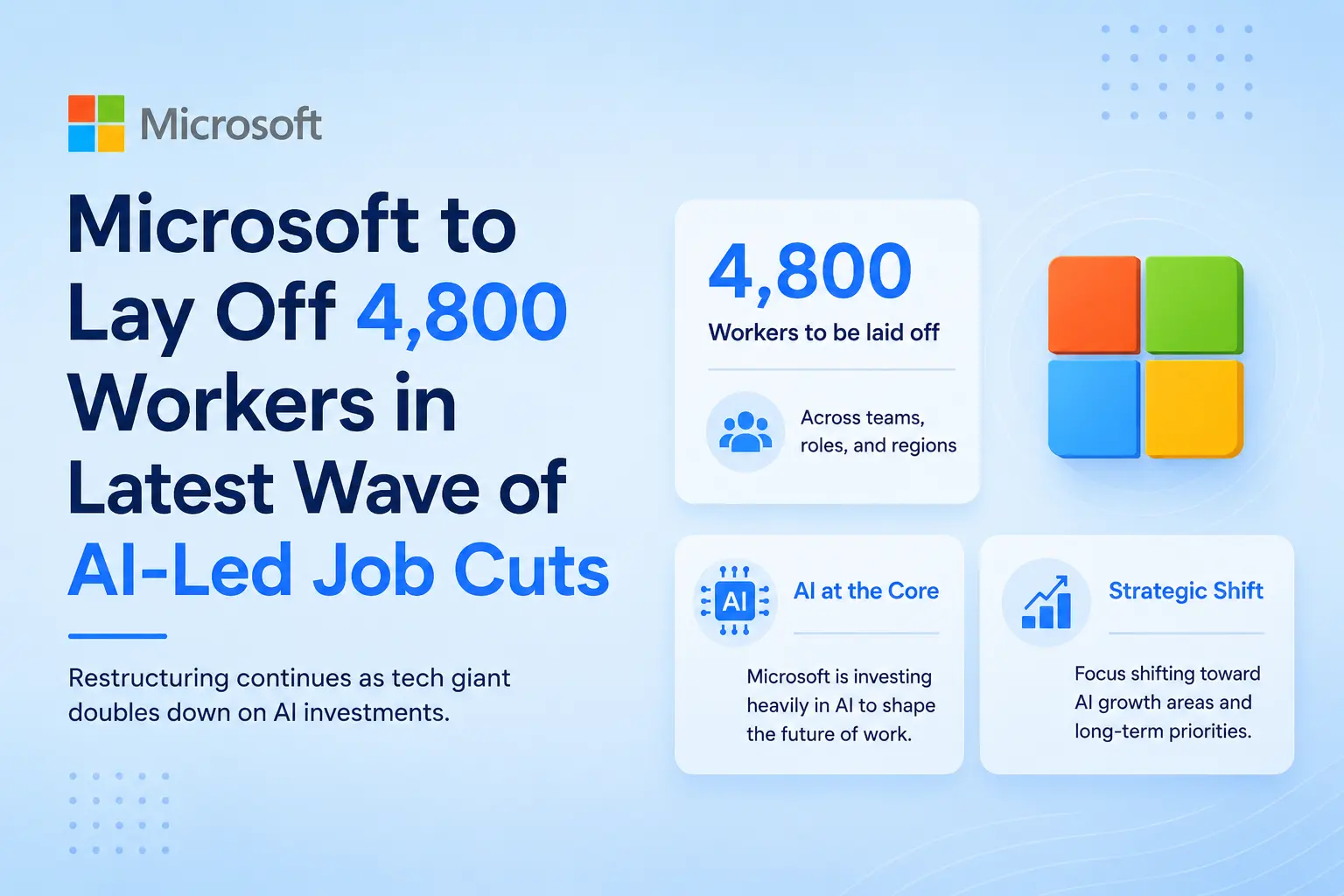
Microsoft is cutting 4,800 jobs — 2.1% of its global workforce — as AI investment reshapes priorities and Xbox absorbs the heaviest blow. Here's what happened, why, and what it means for tech job seekers.
Introduction
Microsoft has confirmed one of its largest rounds of job cuts in recent years, eliminating approximately 4,800 positions — about 2.1% of its global workforce. The announcement, made through an internal memo from Chief People Officer Amy Coleman, places Microsoft firmly within a growing list of major technology companies restructuring their workforces as they pour unprecedented sums into artificial intelligence infrastructure.
Unlike some previous rounds of tech layoffs that were framed purely around cost-cutting, this one comes wrapped in a very specific narrative: AI is not replacing these workers directly, the company says, but it is fundamentally changing how work gets done — and that shift is reshaping which roles the company needs going forward. For professionals in tech, gaming, and adjacent industries, this story is worth understanding closely, both for what it says about Microsoft's priorities and for what it signals about the broader job market. If you're currently navigating a layoff or simply keeping an eye on where hiring is headed, you can explore current openings across tech and other sectors on HireDoor's job listings.
The Headline Numbers
Microsoft's cuts affect roughly 4,800 employees globally, representing 2.1% of its total workforce. While that percentage may sound modest compared to some of the steeper cuts seen elsewhere in the tech industry over the past few years, the scale in absolute terms is significant — and the way the cuts are distributed across the company tells its own story.
According to Coleman's memo, the restructuring is designed to better align Microsoft's workforce and investment priorities with what she described as a rapidly changing technology landscape. Before resorting to layoffs, the company says it explored alternatives, including redeploying more than 4,000 employees into new roles over the past year, reassigning another 500 workers this month, offering a voluntary retirement program, and transferring four gaming studios to new ownership or management.
That framing matters. Microsoft appears keen to position these cuts as a last resort after exhausting internal mobility options, rather than a first-line cost-cutting measure. Whether that framing lands with affected employees is, of course, a separate question — and one that will likely play out across employee reviews, social media, and industry commentary in the weeks ahead.
Xbox Bears the Brunt of the Cuts
While the layoffs touch multiple parts of Microsoft's business, including its commercial division, the single biggest impact falls on the Xbox gaming division. In an email to Xbox employees, the unit's CEO, Asha Sharma, described the changes as the most significant restructuring in Xbox's history.
Sharma outlined a two-phase reduction: approximately 3,200 roles will be eliminated at Xbox throughout fiscal year 2027, with about 1,600 of those cuts happening immediately as part of Monday's announcement, and the remaining 1,600 to follow gradually over the coming year. In addition, four gaming studios will be leaving Xbox entirely for new management or ownership structures — a move that suggests Microsoft is actively trimming its first-party game development footprint rather than simply reducing headcount evenly across the board.
By some estimates, the Xbox cuts amount to roughly 20% of the division's total employees — a striking figure for a business unit that has long been considered central to Microsoft's consumer identity. Sharma pointed to weaker-than-expected performance in Xbox's Game Pass subscription service as one factor behind the restructuring, candidly telling staff that the division's business today is not healthy.
For professionals working in gaming, game development, or related creative-technical roles, this is a sobering signal. It suggests that even flagship consumer gaming brands are not insulated from the broader pressure tech companies are facing to demonstrate returns on their AI investments. If you're a gaming industry professional affected by these changes or exploring your next move, browsing openings in software, product, and creative technology roles on HireDoor can be a useful starting point for mapping out alternative opportunities.
The AI Framing: 'Not Replacing, But Changing How Work Gets Done'
One of the more closely scrutinised aspects of this announcement is how carefully Microsoft has worded its explanation. In her memo, Amy Coleman was explicit: none of the eliminated roles are being replaced by AI. At the same time, she acknowledged a more nuanced reality — that artificial intelligence is automating some of the routine tasks employees used to perform, and that this shift is contributing to the broader restructuring of the workforce.
Coleman's message to employees captured this tension directly, noting that some of the tasks the company does every day can now be automated, and that everyone needs to keep learning, keep building new skills, and keep adapting as the work evolves. She added that Microsoft's customers are navigating the same shift and are counting on the company to help guide them through it — a framing that positions the layoffs not just as an internal cost measure, but as part of a broader industry transition that Microsoft wants to be seen as leading rather than merely reacting to.
This kind of language — technically denying direct AI replacement while acknowledging that AI is reshaping the nature of work — has become increasingly common across the tech sector. It reflects a genuine complexity in how companies are approaching workforce planning: AI tools are rarely eliminating entire job categories overnight, but they are quietly reducing the number of people needed to accomplish the same output, particularly in areas like software testing, documentation, customer support, and certain engineering functions.
For job seekers, this distinction is worth taking seriously. It's not that your specific job title is being replaced by a chatbot — it's that the total headcount needed to do a given body of work is shrinking as AI tools handle a growing share of routine tasks. Building visible, demonstrable AI literacy into your skill set — regardless of your role — is quickly becoming less of a differentiator and more of a baseline expectation. You can explore roles that specifically value these emerging skill sets on HireDoor's jobs portal, where AI-adjacent skills are increasingly listed as requirements even outside core engineering roles.
Part of a Much Bigger Industry Pattern
Microsoft's layoffs don't exist in isolation. They arrive as part of a broader wave of workforce reductions across Big Tech, with companies like Amazon and Meta Platforms also having laid off thousands of employees this year. The pattern is consistent: massive capital investment in AI infrastructure on one hand, paired with workforce reductions in adjacent or overlapping functions on the other.
The scale of this AI-driven capital spending is genuinely enormous. Industry-wide capital expenditure on AI infrastructure across companies like Google, Microsoft, Meta, and Amazon is projected to reach roughly $700–725 billion this year alone — a dramatic increase from prior years. Microsoft itself has set record capital expenditure plans, driven in part by rising component costs and the need for expanded cloud capacity to support AI workloads.
This creates a somewhat paradoxical picture: companies are cutting thousands of jobs even as they spend hundreds of billions of dollars on AI infrastructure, data centers, and compute capacity. From a business perspective, the logic is that this capital investment needs to eventually translate into efficiency gains and new revenue streams, and workforce restructuring is one lever companies are pulling to demonstrate financial discipline to investors while that payoff materializes.
For Microsoft specifically, this pressure has shown up starkly in its stock performance. The company has reportedly been the worst performer among megacap tech stocks in the first half of this year, with shares falling significantly as investors express concern about whether generative AI might eventually displace large swaths of enterprise software demand, while Microsoft's own AI products and services have yet to become the runaway hits that would justify the scale of investment. In this context, workforce reductions can also be read as a signal to markets — a way of showing that Microsoft is willing to make hard operational choices even as it continues its aggressive AI spending.
What This Means If You Work in Tech (Or Are Job Hunting)
If you're currently employed at Microsoft, in the broader tech industry, or actively job hunting, this announcement carries a few practical implications worth thinking through:
- Gaming and creative-technical roles may see continued volatility. With Xbox absorbing the largest share of these cuts and additional reductions planned through fiscal year 2027, professionals in game development, community management, and related functions should expect continued restructuring in this space, not just at Microsoft but potentially across the wider gaming industry as studios reassess costs.
- AI fluency is becoming table stakes, not a bonus. Even in roles that aren't explicitly technical, demonstrating comfort with AI tools — whether for writing, data analysis, coding assistance, or workflow automation — is increasingly what separates candidates who get shortlisted from those who don't.
- Large tech company layoffs often create ripple effects. Affected employees frequently move into smaller, high-growth companies, startups, or consulting roles, which can shift hiring dynamics across the broader industry in the following months. If you're hiring or job hunting in tech right now, expect increased competition for open roles as experienced professionals re-enter the market.
- Diversifying your target sectors is a smart hedge. Given how concentrated recent layoffs have been within a handful of megacap tech companies, professionals with transferable skills may find more stability by also exploring roles in sectors less exposed to this specific wave of AI-driven restructuring.
Whichever category you fall into, keeping your search active and broad is generally the safest strategy in a market this fluid. You can browse a wide range of current openings — across tech, gaming, operations, and other sectors — on HireDoor's jobs portal, and check out career guidance on navigating layoffs and career transitions on the HireDoor blog.
How Microsoft Is Framing Employee Support
Large-scale layoffs inevitably raise questions about how affected employees are being supported through the transition. Microsoft's memo emphasized that the company had tried internal redeployment first — moving more than 4,000 employees into new roles over the past year — before resorting to these cuts, and pointed to a voluntary retirement program as another softer alternative that some employees were offered ahead of the involuntary reductions.
For employees who are ultimately let go, the specifics of severance packages, continued benefits, and outplacement support typically get worked out in the days following such an announcement, and details can vary significantly based on role, tenure, and location. If you or someone you know has been affected by this round of cuts, it's worth carefully reviewing any severance documentation before signing, and considering professional guidance where the terms are complex or unclear.
The Bigger Picture: AI, Efficiency, and the Future of Tech Employment
Microsoft's announcement is unlikely to be the last of its kind this year. As AI capital expenditure across the industry continues to climb into the hundreds of billions of dollars, the pressure on major tech companies to show measurable efficiency gains — often through leaner headcounts — is only likely to intensify. At the same time, this doesn't necessarily mean fewer jobs overall across the economy; it more likely means a redistribution of roles, with growth concentrated in AI-adjacent functions, infrastructure, and new product categories, even as traditional roles in areas like testing, support, and certain engineering functions shrink.
For job seekers, the practical takeaway is less about panic and more about adaptability. Understanding how AI is reshaping specific roles within your industry, proactively building relevant skills, and staying flexible about the types of companies and sectors you're willing to consider can meaningfully improve your resilience in a job market that is clearly in the middle of a significant structural shift.
Conclusion
Microsoft's decision to cut 4,800 jobs — with Xbox absorbing the heaviest impact — is a clear signal of how deeply AI investment is reshaping priorities at even the largest and most established technology companies. While the company insists these roles aren't being directly replaced by AI, the underlying message is unmistakable: the nature of work is shifting, and companies are restructuring their workforces to match that shift, even as they spend record sums on the very technology reshaping the landscape.
Whether you're directly affected by these cuts or simply watching the broader trend unfold, staying informed and proactive is the best strategy. Keep an eye on evolving skill requirements in your field, and if you're actively job hunting, explore a wide range of current opportunities — across tech and beyond — on HireDoor.
Frequently asked questions
How many jobs is Microsoft cutting?
Microsoft is cutting approximately 4,800 jobs, representing about 2.1% of its global workforce.
Which division is most affected by Microsoft's layoffs?
Xbox is bearing the brunt of the cuts, with about 3,200 roles being eliminated throughout fiscal year 2027, including 1,600 immediate cuts and four gaming studios leaving Xbox for new management.
Is AI directly replacing the employees being laid off at Microsoft?
Microsoft says the eliminated roles are not being directly replaced by AI, but acknowledges that AI is automating routine tasks and changing how work gets done across the company.
Why is Microsoft cutting jobs while investing heavily in AI?
Microsoft is restructuring to align its workforce with AI-driven priorities while facing investor pressure to show returns on record AI infrastructure spending, projected at around $190 billion for the company this year.
Are other tech companies also conducting AI-related layoffs?
Yes, Microsoft joins companies like Amazon and Meta Platforms, which have also laid off thousands of employees this year as part of a broader industry shift toward AI infrastructure investment.
Browse by category
Published on hiredoor.in