
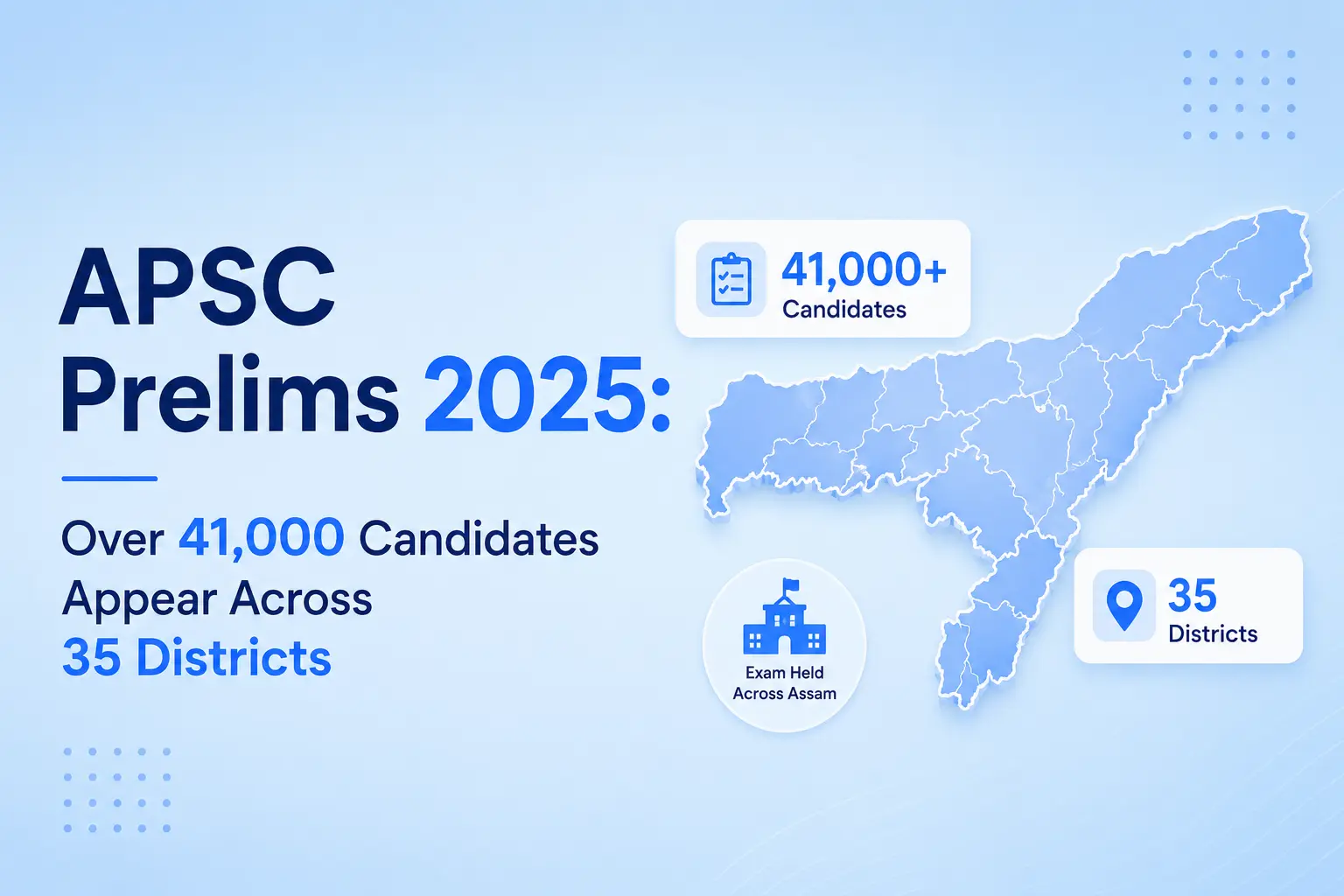
APSC Prelims 2025: Over 41,000 Candidates Appear Across 35 Districts
The APSC Combined Competitive (Preliminary) Examination, 2025 saw record participation across Assam, with Assamese-language question papers introduced for the first time. Here's what it means for job seekers in the state.
Introduction
On Sunday, the Assam Public Service Commission (APSC) conducted one of the state's most closely watched recruitment exams of the year — the Combined Competitive (Preliminary) Examination, 2025. The scale of the exercise was significant: over 41,000 candidates sat for the test across 74 venues spread over 35 districts of Assam. For a state where government service remains one of the most sought-after career paths, this single exam day offers a revealing snapshot of just how competitive — and how important — public sector recruitment continues to be.
If you are among the thousands who appeared for this exam, or if you are simply tracking the government job landscape in Assam, this article breaks down everything that happened, what it signals about the state of public recruitment, and how you can prepare smarter for the stages ahead. And if government jobs aren't your only interest, you can also browse a wide range of current openings on HireDoor's jobs portal to keep your options open while you wait for your APSC results.
Exam Day at a Glance: The Numbers That Matter
The APSC Combined Competitive (Preliminary) Examination, 2025 was held against a total of 78 posts across 11 different services. Against these 78 posts, a staggering 41,695 candidates applied and appeared for the exam — a ratio that underlines just how fiercely contested government recruitment in Assam has become.
Breaking down the candidate pool:
- 23,218 male candidates appeared for the examination
- 18,473 female candidates appeared for the examination
- Four transgender candidates were part of the examinee pool
- 278 candidates with benchmark disabilities (PwBD) also sat for the exam
This gender and inclusion breakdown matters. It shows that Assam's competitive exam ecosystem is drawing participation from a genuinely broad cross-section of the state's population, not just from a narrow demographic. For context, if you're researching how inclusive hiring practices are evolving more broadly — not just in government recruitment but across industries — HireDoor's career resources blog regularly covers diversity and inclusion trends in the Indian job market.
74 Venues, 35 Districts: A Logistical Undertaking
Organising an exam of this scale is no small feat. The Commission had to coordinate 74 examination venues spread across all 35 districts of Assam, ensuring that candidates from remote areas were not disadvantaged by having to travel excessive distances to appear for the test.
According to the Commission, the exam could be conducted smoothly because of what it described as the whole-hearted and sustained assistance and support of the district and police administrations of the districts, along with the Health Department, Postal Department, Municipal Corporations, APDCL, and the principals and teachers of educational institutions that served as exam centres. This kind of inter-departmental coordination is often invisible to candidates but is essential to running an exam that touches nearly every corner of the state.
For candidates preparing for future recruitment cycles, understanding this scale is useful context: APSC exams are not small, localised tests — they are state-wide events involving multiple government departments working in tandem. This is one reason why exam schedules, admit card releases, and result timelines for APSC recruitment can sometimes take longer than private-sector hiring processes. If you're used to the faster pace of private company interviews, it helps to recalibrate your expectations when applying to government exams. You can compare timelines and requirements for various openings on HireDoor, where both government and private sector roles are listed side by side.
What's Actually on Offer: 78 Posts Across 11 Services
One detail that often gets lost in headline numbers is exactly what candidates are competing for. The Combined Competitive Examination is not a single-service recruitment drive — it covers a wide spread of administrative and technical roles across the Assam government. Here is how the 78 posts break down across the 11 services:
- Assam Civil Service — 45 posts (the largest share by far)
- Assam Police Service — 6 posts
- District Transport Officer — 3 posts
- Superintendent of Excise — 1 post
- Assistant Registrar of Cooperative Societies — 2 posts
- Assam Urban Administrative Service — 2 posts
- Inspector of Labour — 5 posts
- Assistant Employment Officer — 8 posts
- Sub Registrar — 4 posts
- Research Assistant — 1 post
- Inspector of Excise — 1 post
The dominance of Assam Civil Service posts (45 out of 78) reflects the broader trend seen in most state-level combined competitive exams across India — administrative service roles typically account for the bulk of vacancies, while specialised services like excise, labour, and cooperative societies make up smaller, more niche slices of the recruitment pie.
For candidates who don't make it through this particular cycle, it's worth remembering that roles like Inspector of Labour, Assistant Employment Officer, and Sub Registrar often have parallel opportunities in allied departments and public sector undertakings. Exploring adjacent government and semi-government roles on a platform like HireDoor's job listings can help you build a broader application strategy rather than pinning all your hopes on a single exam.
A First for Assam: Question Papers in Assamese
Perhaps the most notable change in this year's examination is a linguistic one. For the first time in the history of this competitive exam, the question papers were set in the Assamese language along with English. Previously, candidates had to work primarily with English-medium question papers, which arguably disadvantaged candidates who were more comfortable reasoning through complex questions in their mother tongue, even if their English comprehension was adequate.
This shift mirrors a broader movement across Indian states to make competitive examinations more linguistically inclusive — allowing candidates to demonstrate their actual subject knowledge and reasoning ability without an added layer of language-translation difficulty. It's a change that many aspirants and coaching institutes across Assam have reportedly been requesting for years, and its introduction this cycle marks a meaningful shift in how the Commission approaches accessibility.
For a state with Assam's linguistic diversity, this move could also set a precedent for other recruitment bodies and even private-sector recruiters operating in the region. Employers browsing candidate profiles on platforms like HireDoor increasingly value regional language proficiency as a genuine skill, particularly for roles involving public interaction, field work, or community outreach in Northeast India.
OMR With Carbon Copy: A Small but Important Transparency Measure
Another procedural update this year was the provision of OMR (Optical Mark Recognition) sheets with a carbon copy for candidates. In plain terms, this means that after filling in their answers on the primary OMR sheet, candidates received a duplicate carbon copy to retain for their own records.
This might sound like a minor administrative detail, but it carries real significance for exam transparency and candidate trust. In the event of any discrepancy between a candidate's recorded responses and the official answer key, having a personal carbon copy allows the candidate to cross-verify their submitted answers independently. It also acts as a safeguard against potential tampering or clerical errors during the evaluation process — an issue that has occasionally sparked disputes in competitive exams across India.
Combined with the fact that the provisional answer key was uploaded on the same day as the exam, these measures suggest the Commission is actively working to build more trust and accountability into its examination process — something aspirants across the state will likely welcome.
What Happens Next: The Road From Prelims to Final Selection
For the 41,695 candidates who appeared, Sunday's exam is only the first hurdle. Like most state civil service examinations in India, the Combined Competitive Examination follows a multi-stage selection process:
- Preliminary Examination — the screening stage just completed, designed to shortlist a manageable number of candidates for the next round
- Mains Examination — a more detailed, often descriptive-format exam testing in-depth subject knowledge and writing ability
- Interview/Personality Test — the final stage, assessing communication skills, temperament, and suitability for public service roles
With the provisional answer key already published, candidates can expect the Commission to open a window for objections or representations, followed by the release of results for the preliminary stage. Given the volume of candidates and the scale of cross-checking involved (especially with the newly introduced bilingual question papers), aspirants should be prepared for the process to take some time.
In the meantime, it's wise to use this waiting period productively — begin preparing for the Mains stage, brush up on current affairs relevant to Assam and the Northeast, and keep an eye on notifications from the Commission's official channels. It's also a good idea to keep your job search options diversified during this period. Many candidates preparing for state civil services also apply for allied government roles, banking exams, or even relevant private-sector positions as a backup. You can explore a broad mix of such opportunities on HireDoor's job board, filtered by location, sector, and experience level.
Why This Exam Matters Beyond the Numbers
It's easy to treat a story like this as just another set of exam statistics, but the underlying reality is more significant. Assam, like much of India, continues to see intense competition for government jobs — competition that reflects both the genuine appeal of public service careers (job security, pension benefits, social prestige) and, candidly, the limited availability of comparable opportunities in the private sector across many districts of the state.
A ratio of over 41,000 applicants for just 78 posts — roughly 534 candidates for every single vacancy — is a stark illustration of the employment pressure facing Assam's educated youth. It underscores why government recruitment bodies like APSC carry such outsized importance in the state's employment ecosystem, and why every procedural improvement, from bilingual papers to carbon-copy OMR sheets, matters so much to the candidates involved.
At the same time, this level of competition is a reminder that relying solely on government exams as a career strategy carries real risk. Diversifying your job search — applying to private companies, PSUs, state-run corporations, and emerging sectors like IT, healthcare, and skilled trades — can meaningfully improve your odds of securing stable employment sooner. Platforms like HireDoor are designed precisely for this kind of parallel job search, aggregating openings across sectors so you're not putting all your career eggs in one exam-shaped basket.
Tips for Candidates Preparing for the Next Stage
If you appeared for the APSC Prelims 2025 and are now waiting for results, here are a few practical steps to consider:
- Cross-check your responses using your carbon copy OMR sheet against the provisional answer key uploaded by the Commission, and file objections through the proper channel if you spot discrepancies.
- Start Mains preparation early rather than waiting for the official results — the syllabus for the Mains stage is generally known in advance and typically demands far more in-depth study than the Prelims.
- Stay updated on notifications directly from APSC's official website rather than relying solely on secondary sources or social media, especially given the introduction of new procedural elements this cycle.
- Keep a backup plan active — continue applying to relevant government and private roles so that your career timeline doesn't stall entirely on the outcome of one exam cycle. Browsing current listings on HireDoor is a good way to stay job-market-ready in parallel.
- Refine your resume and interview skills in the background, since the Personality Test stage — if you reach it — will assess far more than just subject knowledge.
Conclusion
The APSC Combined Competitive (Preliminary) Examination, 2025 was more than just a routine government recruitment exercise — it was a state-wide logistical operation involving 74 venues, 35 districts, over 41,000 candidates, and several meaningful procedural firsts, including bilingual question papers and carbon-copy OMR sheets. For the thousands who appeared, the real test is only just beginning, with Mains and interview stages still ahead.
Whether you're one of this year's candidates or simply following Assam's evolving employment landscape, one thing is clear: competition for public sector roles in the state remains intense, and preparation — both for the exam itself and for your broader career strategy — matters more than ever. Keep tracking official APSC updates for your exam results, and in the meantime, don't hesitate to explore a wider set of career opportunities on HireDoor to keep your professional momentum going.
Frequently asked questions
How many candidates appeared for the APSC Prelims 2025?
A total of 41,695 candidates appeared, including 23,218 males, 18,473 females, four transgender candidates, and 278 candidates with benchmark disabilities.
How many posts were the APSC Prelims 2025 held for?
The examination was held against 78 posts spread across 11 different services, with Assam Civil Service accounting for the largest share at 45 posts.
What was new about this year's APSC exam?
For the first time, question papers were set in Assamese alongside English, and candidates were given OMR sheets with a carbon copy for their own records.
In how many districts and venues was the exam conducted?
The exam was conducted at 74 venues across all 35 districts of Assam.
What is the next stage after the APSC Preliminary Examination?
Candidates who clear the Preliminary stage will proceed to the Mains Examination, followed by a Personality Test/Interview for final selection.
Browse by category
Published on hiredoor.in